
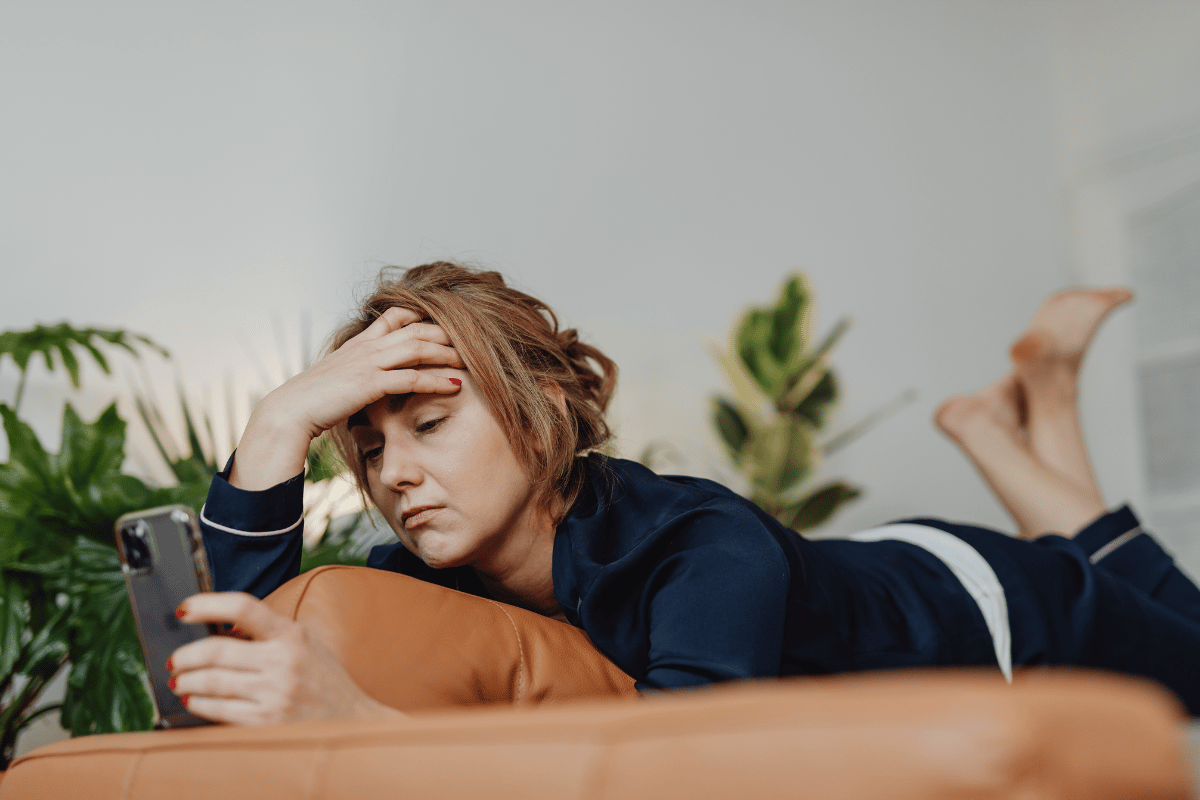
If you’ve ever tried to relax after a long day, only for your brain to suddenly speed up, you’re not imagining it. For some, relaxing can actually make anxiety and physical tension feel a lot more intense at first. If relaxing seems to make you feel worse, you may have wondered, “Why does relaxing make me anxious?” Well, there’s a reason why this happens.
Researchers have spent decades studying relaxation-induced anxiety (RIA). In one study, 5 out of 30 chronically anxious adults became even more anxious during relaxation. This is especially common among those who have a history of trauma or certain mental health conditions, particularly PTSD.
It’s backwards, though, right? Relaxation is supposed to have the opposite effect. In fact, you probably want to relax to get your body out of stress mode. Surprisingly, you may be relaxing physiologically. Your breathing may slow, or your muscles may loosen. Unfortunately, the brain doesn’t only respond to what the body is doing. It also interprets what these responses mean.
Why Relaxing Can Actually Make You Feel More Anxious
If you’re busy, distracted, or moving around, your attention is pointed outward. Once things get slow and quiet, you can become hyper-aware of your breathing, tension, heartbeat, memories, and pretty much every task you haven’t yet completed. If your nervous system is already on high alert, the change itself can be flagged as suspicious.
This is especially common for people who are wired to be hyper-vigilant. Chronic stress or trauma can teach the brain that in order to stay safe, it needs to constantly be on alert. In that state, relaxing can feel less like relief and more like lowering your defenses. Closing your eyes or loosening your muscles can create a sense of vulnerability.
Relaxing Also Removes Distraction
Another reason someone may have relaxation-induced anxiety is because relaxing removes distraction. Relaxing doesn’t cause the thoughts to suddenly start filtering in. Usually, without distractions, the thoughts just become easier to hear. This is why some people feel perfectly functional while working all day and then suddenly start ruminating on previous conversations or worrying about tomorrow the second they get into bed.
Speaking of going to bed, this pattern can become a huge issue for sleep. If you have a habit of trying to force yourself to relax or sleep in bed, your brain can start associating bed with frustration and wakefulness rather than sleep.
So, if you relate to any of this and feel like slowing down somehow makes you feel worse, it doesn’t mean that relaxation is bad for you, or you’ll never be able to relax. Instead, it’s revealing deeper areas you may need to work on.
Start by changing the question from “Why can’t I relax?” to “What does my brain think will happen if I do?” Once you can start identifying that answer, you become closer to understanding the pattern. With the right approach, you can gradually start to unlearn this response.
Your Brain May Think Worrying Is Keeping You Safe
Interestingly, one reason relaxation can feel stressful is that worry may feel productive. Researchers at Penn State have studied this through the Contrast Avoidance Model of generalized anxiety disorder. Basically, the idea is that some people stay slightly worried all of the time because the emotional drop to calm feels too risky. You may think that if you’re already braced for the worst, bad news feels less shocking. If you fully relax and something goes wrong, the jump from calm to distress can feel a lot more intense.
It’s almost like you’re refusing to put down a heavy bag because you’re afraid someone might hand you a heavier one. Staying tense is objectively uncomfortable, but hey, at least it’s predictable. Research has found that sensitivity to this kind of negative emotional contrast is linked with relaxation-induced anxiety in people with generalized anxiety disorder and severe depression.
The Fear of Uncertainty
For others, uncertainty can feel intolerable. Overthinking very possibly outcome, checking messages over and over again, planning ahead, and mentally rehearsing problems before they can happen give you the illusion of control. (Key word: illusion.) However, when this becomes a pattern, your brain starts equating mental activity with responsibility. Taking a break can make you feel guilty or even unsafe.
Physical sensations can also play a role. Highly anxious people can be stressed by normal body changes. If you’re overly aware of your heartbeat, breathing, or muscle tension, and then your brain interprets these sensations as dangerous, you’ve now created a feedback loop. This also explains why relaxation techniques that most experts recommend can backfire for some people. Breathwork, body scans, and meditation all direct more attention inward. For many, this is a calming experience. For someone hyper-aware of their body, it can create a lot of panic.
How To Relax When Relaxing Makes You Anxious
If you try to relax and it makes you more anxious, stop pressuring yourself to be perfectly calm. In fact, pushing yourself to try harder to relax can become part of the problem. The more you monitor yourself and attempt to force yourself, the more relaxation starts to feel like another task you’re failing at. (BTW, you’re not failing at anything.)
Instead, start teaching your brain that it’s safe to not be so vigilant. This takes baby steps, and it takes time, but it can also help rewire your brain so you can stop being in a state of panic. Start by figuring out which part of relaxation bothers you. Is it sitting still? Noticing body sensations? Is it guilt from feeling like you aren’t being productive? Is it the racing thoughts that flood in? Go deeper, ask yourself questions like “If I stop worrying, what do I think will happen?”
Once you have an idea of what you’re subconsciously afraid of, it may be easier to choose a relaxation technique that will best help you to overcome it. But first, start treating anxious predictions like experiments instead of facts. If your brain is telling you, “If you sit down for 10 minutes, you should feel guilty for not being productive,” try the ten-minute break and see what actually happens (likely nothing). Focus on the proof that nothing bad actually happens when you relax. This can take a lot of practice, but over time, your brain will start picking up on the new evidence.
Ease Into It
When doing these experiments, don’t jump into intense meditations or breathwork if that’s what spikes your anxiety. Start with 30 seconds of sitting with your eyes open and your feet on the floor. Loosen your shoulder muscles and look around the room. Alternatively, take a slow walk with gentle music. Doing tiny habits like this each day can start teaching your body that relaxing is safe. As you get more comfortable, you can start working toward longer moments of stillness and quiet.
If you’re someone who doesn’t respond well to breathwork, regulate yourself in ways that feel good for you. Instead of forcing yourself to perform deep breaths, focus on gentle, comfortable breathing. That said, you can also regulate through movement, sensory grounding, music, or other methods.
So, basically:
- Figure out what about relaxation feels threatening.
- Question the belief underneath it. “If I stop worrying, what am I afraid will happen?”
- Choose a low-intensity form of relaxation. Don’t start with meditation if meditation makes you want to crawl out of your skin.
- Practice tolerating a little discomfort instead of immediately escaping it.
- Gradually increase the amount of downtime as it becomes less threatening.
- Experiment until you find relaxation that actually works for your nervous system.
Remember: Sometimes, Working With A Professional is the Best Course of Action
If relaxation triggers severe panic, flashbacks, dissociation, or a major worsening of symptoms, this is a good sign that you should reach out to a mental health professional instead of trying to push yourself through these exercises on your own. Trauma-focused therapy or CBT may be more appropriate, depending on the reason underneath the reaction.
Ultimately, the goal isn’t to become the type of person who can always sit perfectly still with an empty mind. Instead, work on expanding your definition of rest and slowly give your nervous system evidence that you don’t have to stay braced for every second to be safe.